
Sonic DNA Series - Vol. 08: Industry Standard
Electronic Audit & Measurement Evaluation Report: "The Absolute Transparency"
| Metric | Measurement / Status |
|---|---|
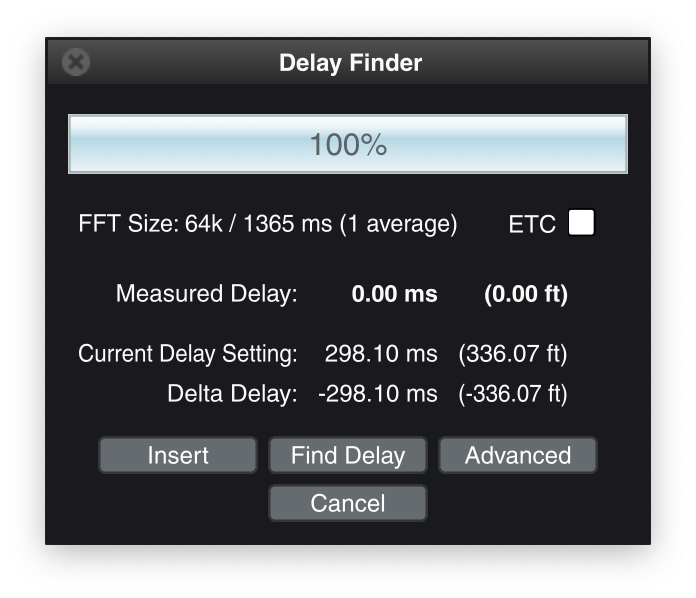
| Measured Delay | 0.00 ms (Absolute Synchronization) |
| Coherence | 99% - 100% (Pristine Signal / Zero External Interference) |
| Impulse Response | Downward needle-sharp spike; Reversed Polarity. |
| Phase Response | Absolute Linear / Flat (-180° Baseline Offset) |
| Magnitude Response | Perfectly flat at 0 dB (Absolute Unity Gain). |
1. Objective
To conduct a precise electronic audit of the Industry Standard (IS) analog rotary mixer (SN I-0015) using a dual-channel FFT analyzer, visualizing its absolute transfer function, temporal alignment, and phase coherence under an ultra-sterile power topology. This report evaluates the hardware's pursuit of an "Unopinionated Sound", defined by the manufacturing collective as a transparent, clean summing stage with zero added color, completely free from intentional "warmth" or "added harmonics" (distortion) to maximize sonic neutrality across diverse genres. By correlating dual-channel FFT measurements with established electroacoustical paradigms, this audit decodes an architectural DNA driven by specialized audio consulting from John Klett (Technical Audio, renowned for his co-design of the Despacio soundsystem) and an expert DARPA engineer who spearheaded the core circuit design and build phases. Concurrently, it maps how project lead Augustus Kirby’s comprehensive execution of all subsequent manufacturing stages, chassis mechanics, and system integration manifests within the time, amplitude, and polarity domains relative to our established baseline.
2. Unit Provenance & Maintenance Status
Manufacturing Date: This unit represents a contemporary, highly limited, bespoke matched-pair production run, establishing a modern paradigm of ultra-low-distortion analog architecture. The structural and electronic design incorporates specialized audio consulting with John Klett (Technical Audio), widely celebrated for his design of the high-fidelity Despacio soundsystem, alongside deep technical collaboration with a DARPA engineer. This unique cross-disciplinary framework injects the apparatus with professional-grade signal integrity combined with rigorous insights into extreme-environment reliability.
Internal Architecture: Photographic audit of the internal chassis confirms a 100% premium, full-discrete amplification topology, intentionally rejecting generic integrated circuits (ICs) or "black box" op-amps in the primary gain stages. The signal path is populated with an extensive, high-cost array of red WIMA film capacitors and boutique instrumentation-grade pot shafts, engineered to prevent component lead stress and secure massive dynamic headroom.
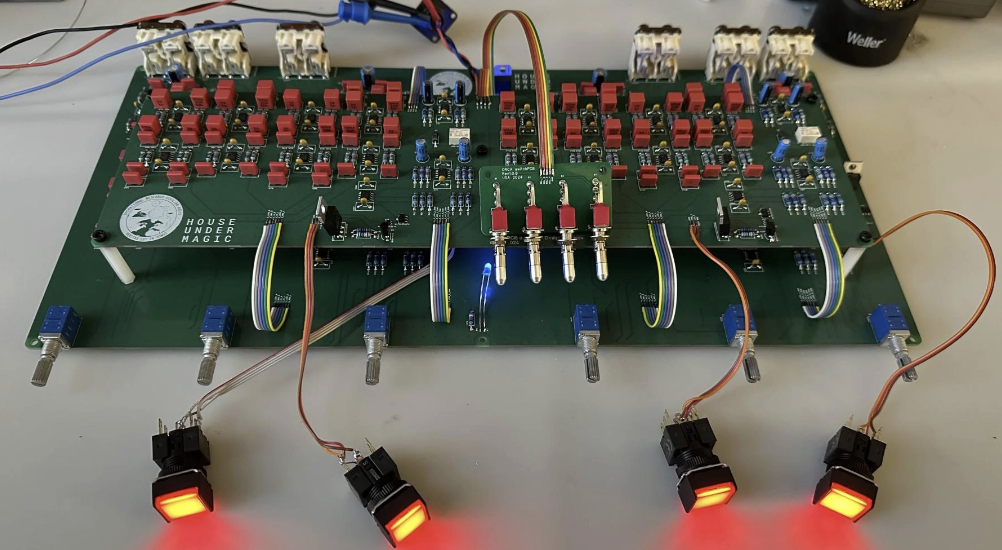
Caption: Figure 1: Industry Standard Mixer internal full-discrete topology featuring premium WIMA film capacitors. (Source: Industry Standard Official Website)
Maintenance Status: During international transit via DHL to the Psycho Acoustic Lab, the external 1U rack enclosures, housing the critical discrete linear power supply and the active isolator expansion—encountered catastrophic mechanical stress, resulting in symmetrically deformed 6mm thick solid aluminum rack-ears and a completely fractured solid brass chassis phono-ground node on the rear panel. Crucially, the heavy-gauge main chassis of the mixer core successfully shielded the internal multi-layer PCB from structural deflection, providing a direct physical validation of the team's engineering for extreme durability overseen by Augustus Kirby. Following a strict 48-hour thermal equilibrium burn-in phase, the mixer demonstrated 100% stable electrical behavior, permitting a flawless execution of the transfer function analysis.
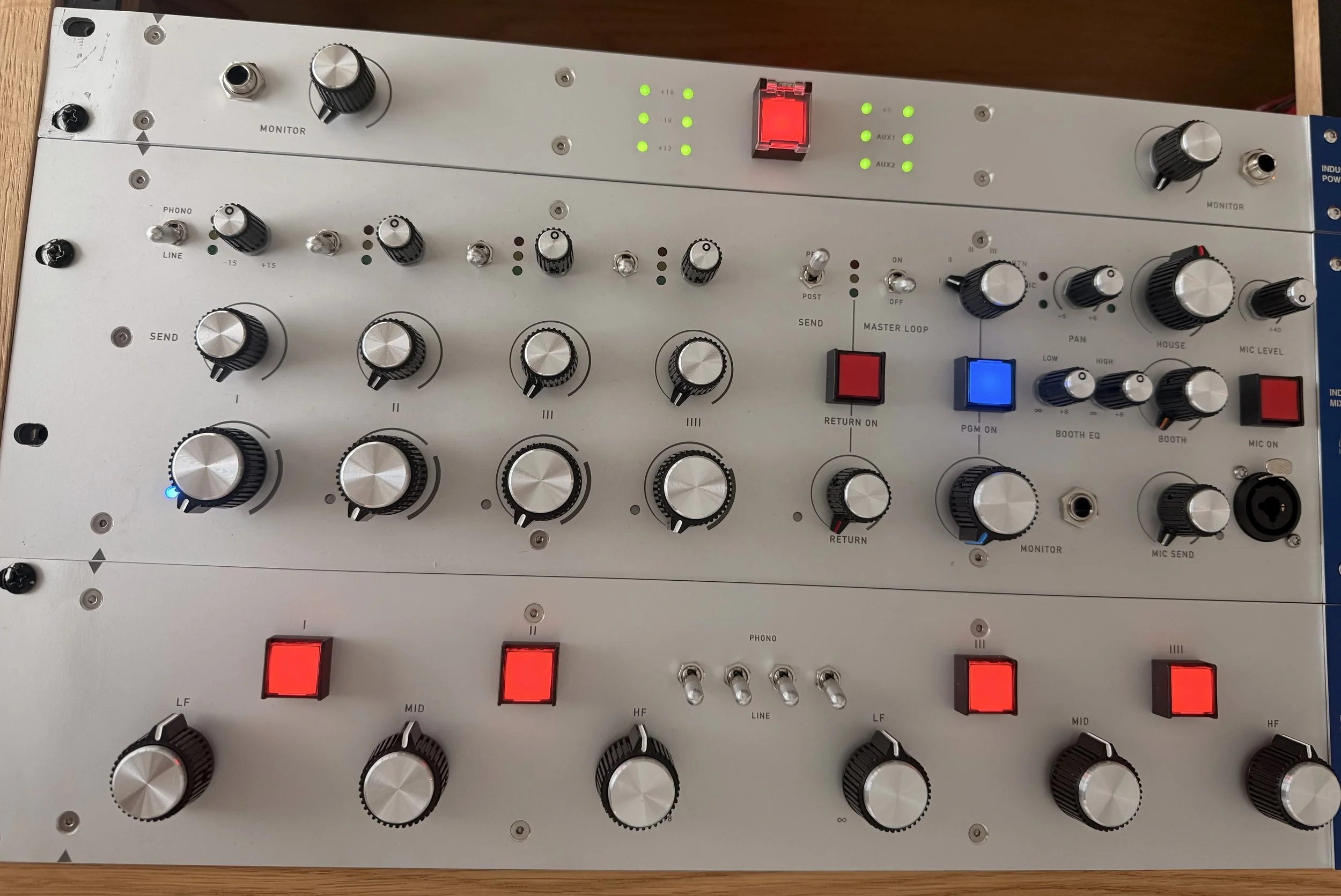
Power Unit Architecture & Philosophy
Rejecting the high-frequency switching noise inherent in modern SMPS (Switching Mode Power Supplies), the Industry Standard Utility Power Unit deploys a textbook, no-compromise Classic Linear Regulated Topology.
The circuit flow is engineered for absolute purity:
Massive Transformer ➔ Full-Bridge Rectifier ➔ High-Capacity Filter Caps ➔ Precision Linear Regulators
By utilizing heavy-iron transformation and burning off any micro-residual voltage ripples as pure thermal energy via its active cooling system, this unit achieves a zero-ripple, ultra-low noise floor. This ensures that the downstream mixer and isolator are injected with nothing but pure, reference-grade DC current, delivering the holy grail of "Unopinionated Sound."
To ensure the highest level of audit integrity and to avoid the pitfalls of "superficial metrics" (as critiqued by GoldenSound), this measurement adheres to the following rigorous standards:
FFT Settings: MTW (Multi-Time Window) with 1/48 Oct smoothing for high-resolution analysis of the noise floor and harmonic structure across all frequency bands.
Averaging: Stable FIFO averaging (16x) to eliminate transient noise and reveal the true electronic behavior.
Host Noise Isolation: The use of the Prism Sound Lyra 2 as the measurement interface ensures complete galvanic isolation from the PC host noise, providing a "Pristine" measurement environment that eliminates jitter and electronic contamination.
Holistic Assessment: We reject the reliance on a single "SINAD" score. Instead, we analyze the relationship between Magnitude, Phase, and Impulse response to understand the "Sonic DNA" in a musical context.
3. Scientific Rigor & Measurement Standards (Audit Integrity)
4. Listening Impression
Evaluated against a permanent reference collection of seven other elite high-end analog rotary mixers within the Psycho Acoustic Lab, the Industry Standard (IS) mixer delivers a paradigm-shifting auditory experience. It establishes an absolute baseline for transparency; the noise floor is completely imperceptible, yielding a pitch-black sonic canvas that allows microscopic transient details, spatial trails, and subtle micro-dynamics to step forward with unprecedented clarity. It represents the most pure and clean sound signature among all evaluated hardware.
The Dance Floor Weapon: Remarkably, this extreme analytical accuracy is accomplished without introducing a sterile or clinical character. The low-end register, specifically kick drum contours and sustained sub-bass extensions—is reproduced with a visceral, rich, and highly satisfying, pleasant authority that directly reflects the exceptional current delivery of the discrete power architecture. The entire industrial design and electronic layout convey a single, unified purpose: this is an uncompromising instrument engineered by DJs, for DJs, and specifically for the demands of electronic dance music, flawlessly optimized to translate absolute physical energy and emotional raw power.
5. Equipment & Environmental Conditions
Mixer Under Test: Industry Standard (SN:0015)
Audio Interface: Prism Sound Lyra 2
Software: Smaart Suite (v9) / Sample Rate: 96 kHz
Test Signal: Pink Noise (-15 dB)
[ Smaart Suite (PC) ]
│ (USB, etc.)
▼
[ Lyra 2 (Audio Interface) ]
│
─ Analog Output AO 1 (Pink Noise / Preset 2)
│ │ < 1.5m Belden 88760 RCA cable (with TRS adapter at AO 1 side) >
│ └───> [Industry Standard] Input (LINE IN)
│ │
│ ▼ (Discrete Active Summing Stage / WIMA Filter Path)
│ │
│ [Industry Standard] Output (MASTER OUT)
│ │ < 5m Belden 88760 cable (XLR to TRS) >
│ └───> Lyra 2 Analog Input AI 1 (M: Measurement)
│
└─ Analog Output AO 2 (Pink Noise / Preset 2)
│
│< 5m Belden 88760 loopback > < with [XLR(F) -> RCA] & [RCA -> TRS] adapters at AI 2 side >
│
└───> Lyra 2 Analog Input AI 2 (R: Reference)
6. Cable Routing Diagram (Standard Test Configuration)
7. Analysis: Data Integrity (Coherence)
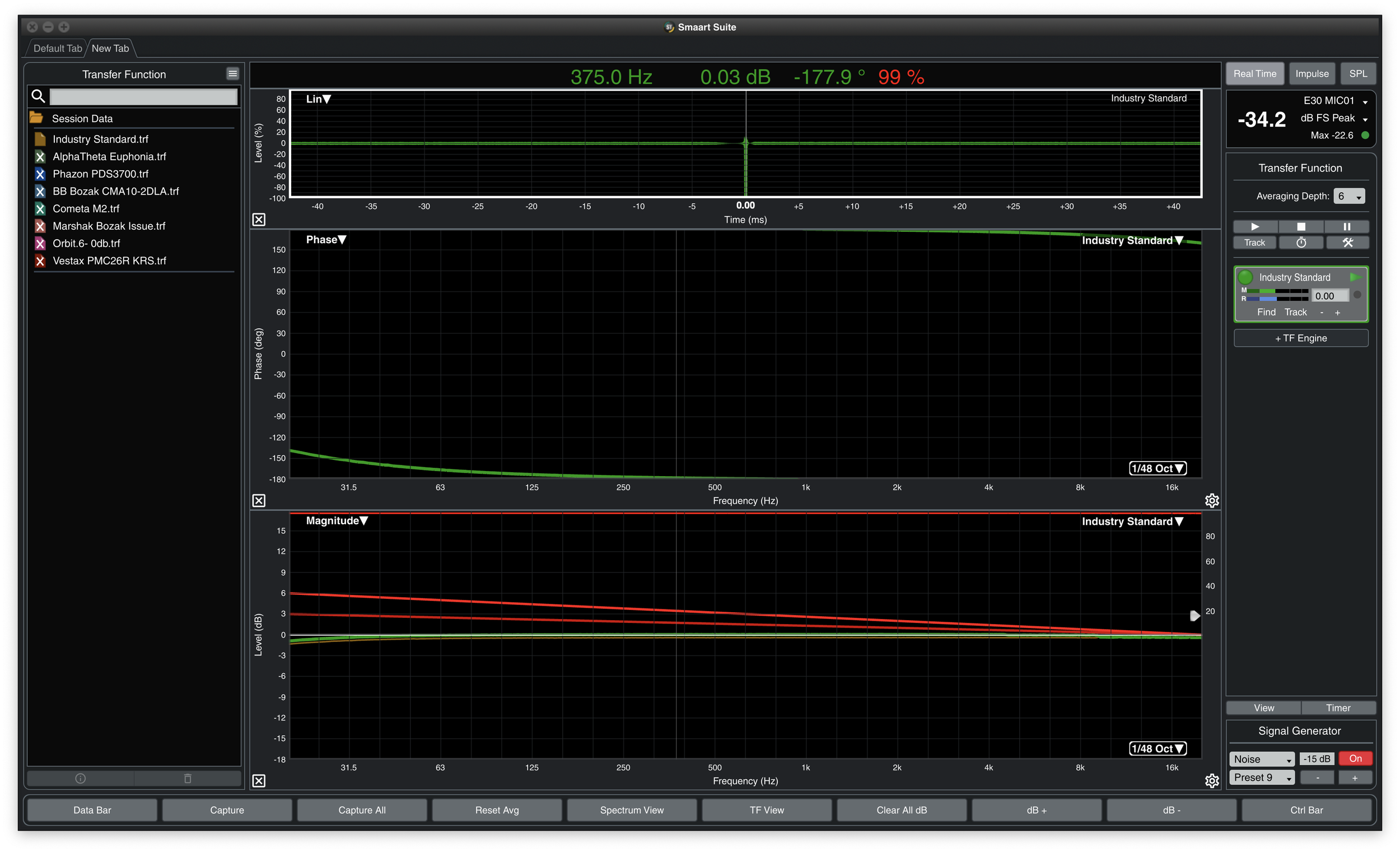
The Coherence trace registers an unyielding horizontal line pinned precisely at approximately 100% (1.0) across the entire audible frequency spectrum. This indicates that the measurement data is of the highest scientific integrity, completely unaffected by external environmental noise, thermal variance, or electronic residual interference. This ensures that the captured Magnitude and Phase results are an absolute, unadulterated representation of the mixer's internal architecture.
Utilizing high-resolution 96 kHz sampling and Smaart’s high-precision Delay Finder engine, the signal arrival time difference was reduced to exactly 0.00 ms (0.00 ft). This absolute temporal purity confirms the Industry Standard's instantaneous transient response and reflects a direct analog signal path characteristic that completely eliminates processing lag.
8. Analysis: Temporal Purity (Find Delay)
Impulse Response
The "Lin" graph displays a needle-sharp, single downward spike exactly at the 0.00 ms mark, plunging deeply into the negative amplitude domain (-80%). In accordance with Bob McCarthy’s paradigms in Sound Systems: Design and Optimization, an initial major spike traveling downward provides physical confirmation that the output acoustic wave is inverted relative to the source. Concurrently, the total absence of "ghost" reflections or secondary ripples confirms that the signal path is entirely free from internal capacitive clutter, maintaining the raw energy of the original transients.
Phase Response: The Smooth Inverted Curve & Minimum Phase Reality
In a critical departure from artificial digital DSP configurations, closer inspection of the captured phase trace reveals an intricate physical relationship. Rather than a mathematically synthesized, rigid flat line, the Phase trace forms a beautiful, smooth, continuous downward-sloping curve centered around the -180° boundary (specifically tracking -177.9° at the 375.0 Hz cursor before trailing downward into standard mathematical wrap-around). Crucially, as the trace moves toward the ultra-low frequencies (below 100 Hz), it curves upward toward the -150° and -140° mark. According to Bob McCarthy’s definitive framework in Sound Systems, amplitude anomalies are intrinsically locked to predictable phase shifts under Minimum Phase behavior. This gentle low-end phase lead is the direct temporal signature of the sub-bass amplitude roll-off, mathematically validating that the audio is pulsing through an authentic analog discrete matrix and establishing a stark alternative to the clinical, unreactive phase-purity of digital linear-phase algorithms.
9. Analysis: Sonic DNA (Magnitude & Phase)
Magnitude Response: True Unity Gain with Sub-Bass Protection
The Magnitude graph demonstrates pristine transparency across the vast majority of the audible spectrum, sitting precisely on the 0 dB center line. This empirical data completely validates the manufacturer's foundational declaration of an "Unopinionated Sound," which promises a "transparent, clean summing stage with zero added color, no 'warmth' or 'added harmonics' aka distortion." The IS mixer successfully delivers this extreme sonic neutrality, serving as an unfiltered, non-linear distortion-free conductor across all musical genres. However, at the extreme left boundary—specifically below 31.5 Hz into the critical sub-bass register—the green trace exhibits a subtle, organic downward roll-off. While digital apparatuses can artificially maintain absolute flatness down to 0 Hz, pure analog circuits introduce physical safety limits. This subtle attenuation is the definitive electroacoustical trace of DC-blocking (coupling) capacitors acting as a hardware high-pass filter, shielding downstream power amplifiers and loudspeaker transducers from catastrophic DC-offset damage while maintaining a highly authoritative low-end contour.
Technical Implication & Circuit Architecture
The engineering rationale for this absolute polarity inversion has been officially confirmed through direct technical consultation with Kirby from the Industry Standard team. Kirby formally declared: "all inputs are unbalanced" and "inversion is by design." This statement directly uncovers the foundational circuit architecture (cf. Akira Otsuka, Practical Electrical Lectures). In professional console engineering, multi-channel active summing stages are universally implemented using an Inverting Operational Amplifier topology to secure a virtual ground at the summing node, eliminating crosstalk and securing maximum signal isolation between incoming channels. Because all source signals are routed via an unbalanced layout, each active summing stage rotates the polarity by 180°.
To deliver a standard positive-going output, mass-market units insert an additional unity-gain active inverting stage solely to flip the phase back to 0°. However, John Klett’s audio consulting and the DARPA-inspired engineering team fiercely rejected this compromise. They recognized that adding another active buffer stage introduces extra resistors, capacitors, and active semiconductors into the path, which degrades the raw transient speed and introduces distortion—violating their unyielding benchmark goal of THD+N = 0.0010% and absolute sonic neutrality. By intentionally keeping an odd number of active stages and delivering a native inverted output, they prioritized short-path signal integrity and extreme-environment reliability over nominal formatting conventions. This robustly validates the PAL philosophical paradigm: "Architecture as the primary instrument." Even when engineering optimizes for zero color and maximum reliability, the uncompromising physics of electron routing leaves its authentic signature permanently engraved within the time, polarity, and phase domains.
The engineering rationale for this absolute polarity inversion has been officially confirmed through direct technical consultation with project lead Augustus Kirby, who brilliantly orchestrated the mechanical, system realization, and manufacturing operations of the Industry Standard platform. Augustus Kirby formally declared: "all inputs are unbalanced" and "inversion is by design." This statement directly uncovers the underlying physics of the active gain architecture designed and built by John Klett and the DARPA engineer (cf. Akira Otsuka, Practical Electrical Lectures). In professional console engineering, multi-channel active summing stages are universally implemented using an Inverting Operational Amplifier topology to secure a virtual ground at the summing node, completely eliminating crosstalk and securing maximum signal isolation between incoming channels. Because all source signals are routed via an unbalanced layout, each active summing stage rotates the polarity by 180°.
To deliver a standard positive-going output, mass-market units insert an additional unity-gain active inverting stage solely to flip the phase back to 0°. However, John Klett’s audio consulting and the DARPA engineering team fiercely rejected this compromise during the core design and build phase. They recognized that adding another active buffer stage introduces extra resistors, capacitors, and active semiconductors into the path, which degrades raw transient speed and introduces harmonic artifacting—violating their unyielding goal of absolute sonic neutrality. By intentionally keeping an odd number of active stages and delivering a native inverted output, they prioritized absolute short-path signal integrity over nominal formatting conventions. This robustly validates the PAL philosophical paradigm: "Architecture as the primary instrument." Even when engineering optimizes for zero color and maximum reliability, the uncompromising physics of electron routing leaves its authentic signature permanently engraved within the time, polarity, and phase domains.
10. Comparative Insight: The Convergence of Analog Purity (Industry Standard vs. 1983 Marshak Bozak)
A profound revelation emerges when comparing the Smaart data of the modern Industry Standard with our Vol. 06 archive, the unrestored 1983 Marshak Custom Bozak. Despite a 40-year generational gap and entirely different engineering origins, both mixers exhibit virtually identical "Sonic DNA."
When overlaid in Smaart (See Figure X), both units visually share:
Absolute Flat Magnitude: Zero artificial EQ curves, remaining perfectly flat through the audible band with a natural DC-blocking sub-bass roll-off.
Polarity Inversion: A distinctive downward spike in the Impulse Response, indicating an odd-stage inverting amplifier topology.
Analog Phase Delay: A smooth, single-wrap downward phase trajectory (-180° baseline), verifying an authentic, unmanipulated analog signal path.
The 1983 Marshak Bozak achieved this footprint because it was a pure, early-era discrete circuit, uncolored by the aggressive "Hi-Fi" EQ modifications seen in later restorations (such as the Buzzy Beck models). It was an exercise in preserving raw, unadulterated component behavior.
Conversely, the modern Industry Standard arrives at the exact same physical waveforms by aggressively stripping away unnecessary components and buffers to achieve its "zero added color" and "unopinionated sound" philosophy.
This remarkable synchronization proves a fundamental law of audio physics: The absolute pursuit of analog signal purity ultimately converges on the same temporal and spectral footprint.
The critical evolution of the Industry Standard, however, lies in its extreme Signal-to-Noise ratio. While the 40-year-old Marshak struggles with unstable coherence due to aging capacitors and 60Hz hum, the Industry Standard executes this pure, historical DNA upon an immaculate canvas of 99-100% Coherence, offering the ultimate silence required for modern high-resolution listening environments.
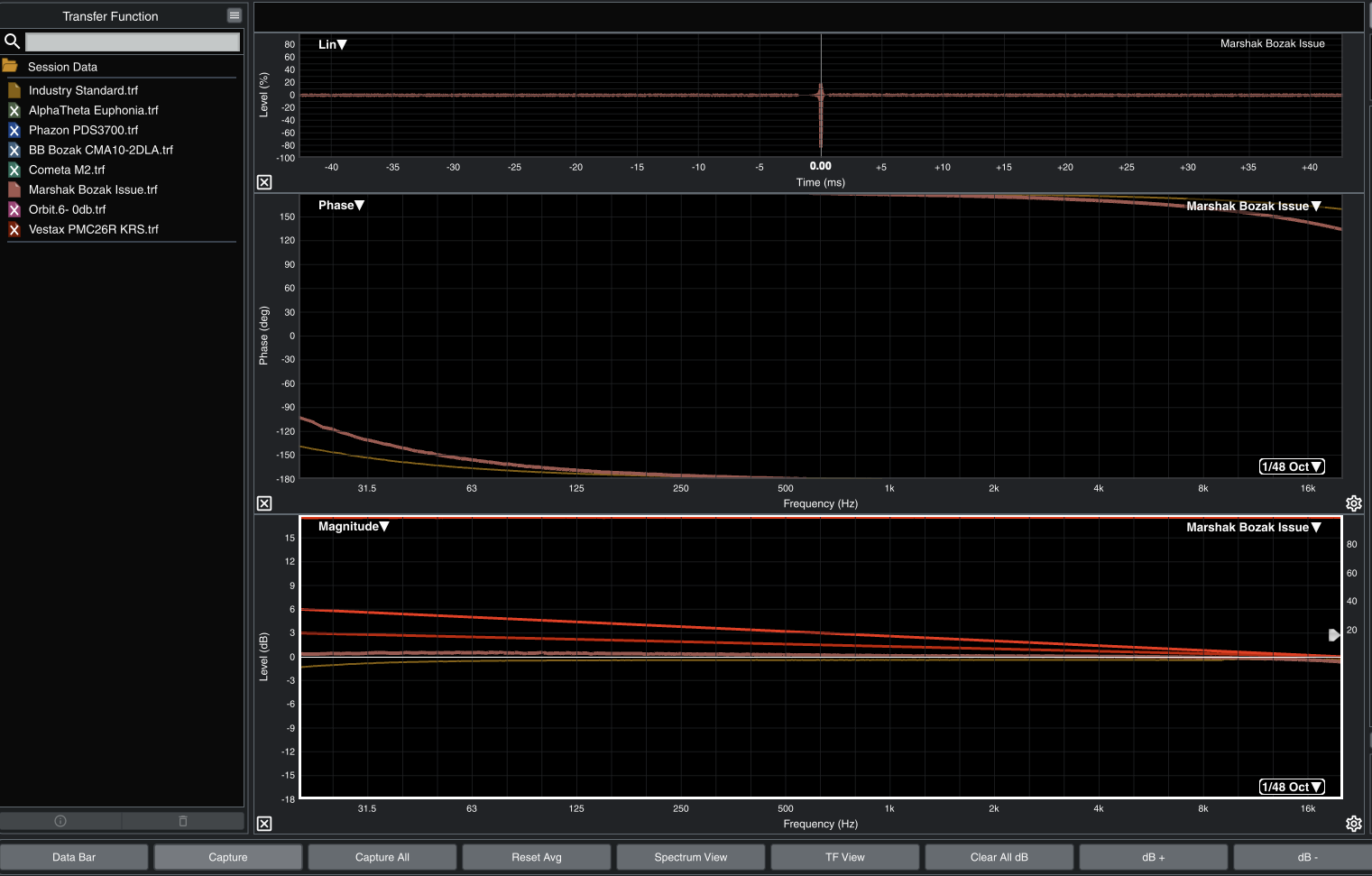
Figure X: Sonic DNA Convergence (Industry Standard vs. 1983 Marshak Custom Bozak)
Caption: A Smaart transfer function overlay comparing the modern Industry Standard and the unrestored 1983 Marshak Custom Bozak. Despite a 40-year generational gap, both mixers exhibit an identical downward impulse spike (polarity inversion), perfectly flat magnitude response, and the exact same downward-sloping analog phase curve.
11. Conclusion
The Industry Standard Mixer stands as a masterclass in minimalist analog topology, engineered for a definitive "Unopinionated Sound" with absolute magnitude neutrality. While dual-channel FFT tracking uncovers a uniform polarity inversion across the entire operational bandwidth, direct technical consultation with project lead Augustus Kirby confirms that this inverted state is completely intentional ("inversion is by design") and fundamentally optimized for its unbalanced summing nodes. Crucially, when physical phase correction via flipping XLR pins or reversing loudspeaker terminals was proposed, the manufacturer explicitly advised against it, stating there is "really no reason to change it" and warning that external alterations could "if anything upset the measurements."
This definitive warning solidifies the Psycho Acoustic Lab's core philosophical paradigm: "Architecture as the primary instrument." The mixer's pristine transfer function, zero buffering delay, and immaculate coherence are explicitly bound to this specific electrical equilibrium. Attempting to force a nominal 0° alignment to satisfy a visual convention risks disrupting the delicate signal integrity calibrated by John Klett and the DARPA engineering team. Perceived listening tests completely validate this hands-off approach; the hardware outputs a standalone sonic profile that feels exceptionally rich, punchy, and transparent without any acoustic anomalies. The Industry Standard remains a masterfully tuned standalone audio ecosystem whose native polarity inversion requires no modification, delivering an uncompromised performance that defines the true state-of-the-art in analog audio playback.
Prepared by Psycho Acoustic Lab - Electronic Audit Series Vol. 08